As part of its efforts towards ensuring that the Super Eagles
get maximum support during the 2014 World Cup, Nigeria Football
Supporters Club has launched a World Cup sticker titled “Goodluck to
Super Eagles”.
President General of the Club, Rafiu Ladipo said during the launch
that the sticker will be used to create awareness for the team even as
he promised that the club will also produce banners, flyers and t-shirts
as a source of support to the team.
“This is just the beginning of what to expect from the Supporters
Club at the Mundial because we want to ensure that the Super Eagles get
maximum support to enable them excel in Brazil.
MTV Base has revealed that multi-talented American actor,
producer, stand-up comedian, writer and film director Marlon Wayans will
be the official host for the 2014 MTV Africa Music Awards.
Wayans follows in the illustrious footsteps of previous hosts such as Wyclef Jean and Eve.
Marlon Wayans first found fame with the TV show “In Living Color”, the
highly acclaimed sketch comedy show that helped launch the careers of
such renowned stars as Jim Carrey and Jamie Foxx. He also co-starred the
comedy sitcom “The Wayans Bros”, a largely autobiographical show based
on the brothers’ real relationship and personalities.
As an actor, Wayan’s movie outings have grossed more than $736 million
at the US box office. Wayans is commonly recognised for his role as
“Marcus Copeland” in the 2004 hit comedy White Chicks, opposite Shawn
Wayans, Jamie King and Terry Crews. Wayans also starred alongside Shawn
Wayans and Regina Hall in the successful spoof horror franchise Scary
Movie and Scary Movie 2.
Alex Okosi, SVP & MD, Viacom International Media Networks (VIMN)
Africa commented, “Marlon Wayans is a hugely popular entertainment
figure known and loved by African audiences from “The Wayan Brothers”
and his various movie roles. His irreverent humour and infectious energy
will definitely make him a great host for the 2014 MAMA.”
The 2014 MAMA is set to feature stunning performances from African and
international artists, including the awards’ signature collaborations
between artists of different genres and cultures – a high point of every
show. The stunning line-up forMAMA 2014 includes R&B superstar
Miguel, hip hop game changer French Montana, Nigerian sensations Davido,
Flavour and Tiwa Savage and South African hit makers Mafikizolo,
Uhuru,Oskido and Professor. Many more artists are due to be announced
next week.
Celebrating musicians and achievers who have made the most impact on
African youth culture throughout the year, MAMA 2014 will, for the first
time ever, premiere LIVE across Africa on MTV Base (DStv Channel 322)
and MTV (DStv Channel 130) at 21:00 CAT. The show will also air
tape-delayed across BET’s international footprint. A one-hour MTV World
Stage special will also air around the world.
Taking place at the International Conference Centre, Durban on June 7,
The MTV Africa Music Awards is brought to you by KwaZulu-Natal Province
in association with Absolut and The City of Durban. South Africa Tourism
is also a partner to the MAMA.
With hundreds of thousands of votes already cast, public voting for 2014
MTV Africa Music Awards continues online at www.mtvbase.com until
midnight on June 4, 2014. The winners of the MTV Base Leadership Award
and Best Video are chosen exclusively by MTV Base. Voting for Song of
the Year continues up until the show on June 7. Stay up to date, follow us on Twitter; @thundergist
Benin City came alive on Friday 23rd
May 2014 as Orijin the refreshing bitter-sweet herbal drink host its
numerous connoisseurs to the party of a lifetime. The event took place at the Jokers club and it
saw a large turn-out of people who came out to party to the beat with
Orijin.
DJ Sosse was in the house and he dropped beat
after beat that left the crowd yearning for more. Continue to see more photos...
Were the police right to get the rapper arrested for weed?
Wiz Khalifa arrested for possession of weed
Rapper Wiz Khalifa was arrested at the El Paso airport on Sunday for drug possession.
A
TSA agent reportedly found what has been described as "green leafy
substance" in his possession as he was boarding a flight to Dallas.
It's comes as no surprise asAmber Rose'shusband has never hidden his love of marijuana, but he took a selfie and tagged it "Free Trap Wiz" while he was waiting to be processed.
He
later added, "EP is the only place that would arrest a rapper" and then
wrote, "They're trying to figure out how many grams I had, How iconic."
Funny thing is his new single is called "28 Grams," so please do the math
play
Conjoined twin girls in Australia die after 19 days of life
The conjoined twin girls of
Australian origin, whose miraculous birth on May 8 shocked the world,
have finally died at a hospital in Australia today, May 27 after living
for just 19 days.
Hope and FaithHowie
shared a body but had two separate faces and separate brains. The girls
survived a miraculous birth and were christened on May 8. Both were
born with an extreme rare condition medical experts have termed, disrosopus – which leads to a baby with two faces.
According to statistics, only less than 40 people in history are believed to have suffered from the same condition.
The girls’ mother Renee Young earlier told Women's Day
that unless anyone sees them before it could be believed they truly
exist adding that they both developed their own personalities.
"Sometimes
Faith will cry and wake Hope up, who then looks sideways as if to
say...Thanks for that. We are blessed we've got this far. I just find
them adorable."
According to reports, Renee Young
was originally advised to terminate the pregnancy but said her amazing
little girls had a reasonable chance of survival if they made it to the
five week mark.
'Each time I come means they've reached another milestone and pulled through another day,' their father Simon Howie said.
Renee reportedly went into labour at just 32 weeks.
I postponed my rebuttal on “WHY WAS THE PROPHET NOT ALLOWED
TO WRITE HIS WILL?” to another week in order to write on the third
Annual General Meeting (AGM) of the Association for Hajj and Umrah
Operators of Nigeria (AHUON), which took place on Tuesday, May 13th,
2014 at the Main Auditorium of the National Mosque, Abuja.
The AGM, with today’s caption as its theme, charted a new course for
AHUON, and provided it with new set of leaders in an electoral process
devoid of chaos and rancour.
In his welcome address, the outgoing President of AHUON, Alhaji Nasir
Mohammed Sala Koko, urged members to call to mind what obtained in the
past concerning Hajj and Umrah operations, and compare it with we have
today, to appreciate the tremendous achievements garnered during the
period of his stewardship. He prayed for the continuation of the
cooperation and support of NAHCON and the Saudi Arabian Hajj authorities
in ensuring better services to pilgrims.
Alhaji Nasiru also called on the Central Bank of Nigeria to address
inflation ‘and stabilize’ the ‘exchange rate of Naira to dollar’ so that
we can enjoy stable Hajj rates. In other countries, he said, pilgrims
pay the same amount of money for five years running due to the stability
of their currencies. Fluctuating Hajj rate, according to him, is giving
Hajj operators a bad name, and denting their image.
On Hajj seat allocation to tour operators, Alhaji Nasiru, the
outgoing President has this advice for NAHCON: ‘…competent, experienced
and tested hajj operators are not getting enough allocations. When those
with capacity, quality service delivery and genuine interest in the
business are not patronized, then the future of hajj operation in
Nigeria is best imagined. I hereby humbly request for upward review of
hajj allocation by adopting 70:30% ratio between the public and private
sector.’
The Special Guest of Honour, Alhaji Muhammad Musa Bello, Chairman/CEO
of NAHCON dwelt on the cordial relation he enjoyed with AHUON under the
leadership of Alhaji Nasiru Sala Koko. ‘I recall’ Said the Chairman,
‘how some five of you started this association many years ago, at a very
great financial, psychological cost. Pioneering, you will agree with
me, is a very difficult exercise.’ He then advised Alhaji Nasiru not to
assume the energy and expense expended in forming AHUON as loss. ‘It is
from today that you will start to rip the benefit’ of your collective
exertions. ‘I am saying this,’ continued the Chairman, ‘because I knew
what it was, and know what it is now’.
NAHCON Chairman was alluding to the pioneering effort of Alhaji
Jelili Animashaun of Al-Hujjaj International Services, Hajiya Fadilat
Isa Mohammed of Finest Travels and Tours, Alhaji Nasir Sala Koko of
Nazia Air Services and Dr Abdul Waasi Gabadeen. These four together with
late Dr Abdul Lateef Adegbite, who was the Chairman, Board of Trustees,
initiated what we see today of ‘private sector involvement in the
management of Hajj and Umrah operations in Nigeria’.
The Guest Speaker and Honourable Commissioner of Operations, NAHCON,
Abdullah M. Mohammad Esq cautioned AHUON on ‘over speeding’ in trying to
‘navigate to the next level’, because ‘speed kills.’ Even though he did
not have a written speech, the Commissioner spoke eloquently and
addressed the topic professionally. He called on the new leadership of
AHUON to seek to ‘harness, but not to disperse.’ He advised them to
build on the good works that the outgoing executives started by
addressing challenges, avoiding ‘personal, selfish interest’ in the
discharge of their duties. Leadership, in his view, is key, because, he
said in Hausa, ‘In kaga sallah ta lalace, to daga limanne.’
Meaning, the imam, being the one leading the congregation, is
responsible, where the prayer vitiated. The Commissioner extoled the
virtues of the outgoing executives in the selfless services they
rendered AHUON. ‘In their dealings with me,’ he said, ‘from Alhaji
Nasiru, the President, to the last person in the hierarchy of AHUON,
none of them has ever asked me for personal favour. Wallahi, I don’t
even know the names of their companies.’
The Guest Speaker, therefore, urged the incoming executives and all
AHUON members to emulate the commendable traits of the outgoing
leadership. He said AHUON should be ‘one, united house’ where members
are allegiant to the leadership, where personal opinions give way to
that of the majority, and where members pay their ‘dues for the
advancement of the association’. AHUON, he said, should spare no effort
or expense in becoming ‘a professional body’, like Professional
Institute of Hajj Operations in Nigeria.
After this opening ceremony, the meeting went into a closed-door
session where outgoing officials made further presentations. Alhaji
Nasiru gave report of his team’s stewardship where he traced stages of
AHUON’s formation, challenges and achievements, from its infancy to the
present position.
The Secretary-General, Dr Abdul Waasi’ Gabadeen presented the
‘Proposed Constitutional Amendments’ most of which was ratified by
members. He ended by saying that the National Executive Council, ‘NEC
members unanimously considered and ratified the appointment of DR. Abdul
Waasi’ Gabadeen as the Executive Secretary of AHUON as from 14th May,
2014 for the 1st term of 4-years with no official salary attached to the
office but allowances shall be provided for some basic services
rendered or expenses incurred for the Association.’
I did not intend to speak for the duration of the AGM, but listening
to what Dr Gabadeen mentioned of not attaching official salary to the
Executive Secretary of AHUON, I had to speak. ‘Mr President,’ I began,
‘we are a business concern. We should be able to pay the salary of our
Executive Secretary. Afterall, the person nominated and ratified for the
post is well known to us. None of us here has put one-tenth of the
efforts that Dr Gabadeen is putting, day and night, to ensure that we
reach where we are today. We called him Secretary-General, which was an inadvertent misconstruction, he should have been General-Secretary, but Allah made him serve that purpose according to the real meaning of Secretary-General.
That is what you have at the Arab League and the United Nations for
example. They have Secretary-General, who is the CEO, who directs the
entire body of the organisation. Yes, Dr Gabadeen was that and more for
AHUON. He oversaw the secretariat, wrote all letters and speeches,
represented us with excellence in local and international forums, and
was a competent image-maker of AHUON. So, why should we not pay him full
remuneration? I think should do that even if he rejected it.’
Members, with some modifications, accepted this proposition. Yes,
there should be full remuneration for the office, and not the
individual.
The elections brought in Alhaji Abdulfattah Abdulmajeed as the new
President of AHUON, who hitherto, was the Chairman of AHUON, Lagos Zone.
In his acceptance remarks, President Abdulfattah of AHUON started with
Khutbatul Haajah (Innal Hamda lillaah…) which the Messenger of
Allah enjoined us to start our public presentations with. He remaindered
his listeners that Allah grants leadership to whom He pleases. On the
achievements of his predecessors, he acknowledged their efforts in
creating, nurturing and raising AHUON to what it is today; that his team
will ensure that the tradition they established is built upon,
sustained and navigated to the next level. ‘This is a transitional
period in this industry.’ He said, ‘the period of Haram Expansion in
Makkah and Madeenah. Before the expansion of the Haramain were taking 3
to 4 million pilgrims during Hajj, and about 10 million during the
yearlong Umrah season. When the expansion of the Haramain is complete in
two years or so, the number of pilgrims in Hajj shall be raised to 10
million and that of Umrah to 80 million.’ Therefore, the President
advised members to be more committed in the activities of an industry
from where we get our bread and cheese, and which, above all is the
fifth pillar of our faith. The post Haramain expansion years will
determine who will remain in the business and who will wiped-out the new
realities, he said. He expressed gratitude the NAHCON for its advocacy
and encouragement in ensuring standard service delivery to pilgrims, and
sanity in the industry
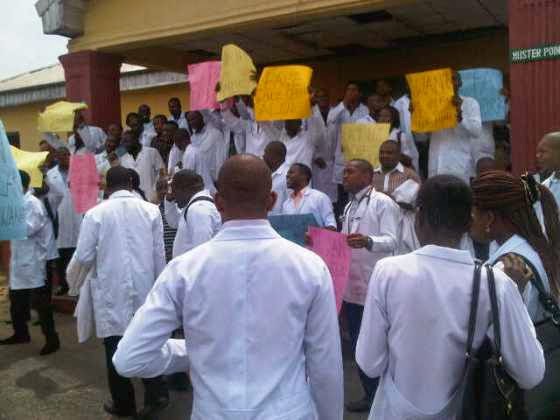
Doctors at Federal Medical Centre Owerri today protested over unpaid wages and said they will soon embark on indefinite
strike. The doctors complained that the FMC management has formed a habit of not paying salaries and
entitlements, and with so many deductions when they eventually pay.
Someone in the know said the residents haven't been paid September 2013 salary. The house
officers who worked for 3 months received payment for only two months
with so many deductions. They say this is not fair considering the health hazards
they are exposed to on a daily basis and the fact that they are always away
from their families on call only to have their salaries cut in half. See more pics from the protest after the cut...
Nigeria needs over $30billion to put needed infrastructure in
place to produce and utilize 3-4billion cubic feet of gas per day in
2015 as against over 1.4 billion cubic feet of gas being presently
flared away on daily basis from her proven gas reserve of 187 trillion
cubic feet according to the Chairman , Senate Committee on Gas
Resources, Nkechi Nwaogu.
Senator Nwaogu made the disclosure yesterday in Abuja at a
conference organized by the committee in collaboration with the Federal
Ministry of Petroleum Resources, Nigerian National Petroleum Corporation
(NNPC) and other relevant stake holders.
She stated that Nigeria has a paradoxical situation of occupying the
top position in gas reserve and production but last position in gas
utilization amongst other naturally endowed countries of the world, such
an investment cannot be avoided by Nigeria in view of the fact that the
future of her energy is gas.
Nwaogu said, “the future of Nigeria’s energy is gas with a proven gas
reserve of 187 trillion cubic feet and a potential reserve of 600
trillion cubic feet which make Nigeria to be the 6th largest producer of
liquified petroleum gas (LPG) in the world and the largest on the
African continent but the low utilization of natural gas in the country
has made ours to be a paradoxical situation.
“While we occupy the top position in gas reserve and production, we
equally occupy the last position in gas utilization with the current per
capital consumption of natural gas in Nigeria at about 1.06kg, ranking
her lowest in Africa with only 5% of her citizens having access to
domestic gas.”
“The low utilization of natural gas in the country is greatly hinged
on the inadequacy of gas transmission and distribution infrastructure
which results to Nigeria flaring about 1.4 billion cubic feet of gas per
day, second to Russia in the world in gas flaring.
“Thus, to practically address the ugly tide as recently submitted by
development experts, a significant investment of over $30billion on
infrastructure is needed to achieve Nigeria’s target of producing 3-4
billion cubic feet of gas a day by 2015”.
She added that the aim of the conference with the theme:”Deepening
Domestic Utilization of Natural Gas and Routine Flare Elimination”, was
to look at ways of filling the huge gaps between gas production and
utilization in the country as well as reducing routine gas flaring.
According to her, since the quantity of natural gas in Nigeria is
said to be more than twice the quantity of crude oil with estimated
reserve production ratio of about 120 years compared to that of crude
oil which is just 42 years, Nigeria needs to carry out the needed
investment in the gas sector for optimum utilization of gas production
for the benefit of all.
In his Keynote address Senate President, David Mark urged all the
stake holders in the sector to use the current gas revolution for
betterment of lives of people and not just limiting it to the natural
hydrocarbons and wealth.
According to Mark in an address read on his behalf by the Senate’ s
Minority Whip, Senator Abu Ibrahim, the gas revolution which has come
upon the country, is not just about hydrocarbons and wealth but also
about human beings as regards betterment of their lives in various ways.
He said: “Indeed the gas revolution has come upon us. however, I need
to stress that the revolution is not just about hydrocarbons and
wealth. It is also about human beings and the betterment of the lives of
people, their communities and the entire society.
“We have to explore the varying opportunities of this revolution and
chart a sustainable way forward for the development of our people since
the revolution does not only engender the creation of a plethora of new
jobs but also serves as a springboard for the rebirth of the non-oil
sector in our country, such as manufacturing, agriculture, solid
minerals and so on”.
Mark also admonished policy makers to ensure that exploration
activities are not detrimental to the social and environmental
conditions of the immediate communities where exploration are taking
place hinting that the much delayed Petroleum Industry Bill (PIB),
before both chambers of the National Assembly , will soon be passed.
“Although we are still saddled with the PIB but will be passed soon
to provide the needed enabling laws for the reformed oil and gas sector
that will be to the benefit of all including the host communities”, he
said.
However the Minister of Petroleum Resources, Diezani Alison Madueke
disclosed at the conference that government was already putting massive
and robust infrastructure in place for optimal utilization of gas
production in Nigeria to redress the initial in adequate capacities.
“In the last three years , we have begun the most aggressive
implementation of a nationwide gas infrastructure blueprint. Our vision
is to connect via a national grid to key supply sources and to markets
across the nation driven by our conviction that a robust infrastructure
is the minimum requirement for supply and market growth”, she said.
Hoboken, N.J., residents walk through flood
water in the aftermath of Hurricane Sandy. Mayor Dawn Zimmer is
advocating for better planning and increased funding for flood-prone
urban areas.
Charles Sykes/AP
Last week, scientists warned that a massive chunk of the West
Antarctica Ice Sheet will eventually drift into the sea and melt,
raising sea levels at least 10 feet higher than previous predictions.
Even before the announcement, scientists at the nonprofit research organization that surging seas could put the homes of nearly 5 million Americans underwater by the end of this century.
Dawn
Zimmer, mayor of Hoboken, N.J., is a member of President Obama's Task
Force on Climate Preparedness and Resilience. She's one of many elected
leaders in coastal areas around the country working to stave off future
flooding disasters.
Zimmer says that the devastation caused by
Hurricane Sandy — and the four floods that have hit her city since —
moved her to action. Hoboken's strategy, she tells Morning Edition's
Renee Montagne, includes purchasing land and building new parks to help
absorb rainwater; retaining as much rainwater as possible and updating
the city's drainage and pumping systems. "We need to figure out a way to
live with water," she says.
Interview Highlights
On Adaptation
We're
living with climate change right now. We've had ... four major flood
events [since Hurricane Sandy]. So that means people's cars are totaled,
people's homes are still getting flooded. We're seeing it on a regular
basis, these heavy downpours. So, to a certain extent, the climate
change assessment that just came out reaffirms what we absolutely have
to do. ...
I'm hopeful that we're going to implement this
integrated strategy that is going to allow us to live with water.
[Hoboken] potentially can be a model for this. ...
We have an
opportunity that was impossible for other species. I'm sure that if the
dinosaur could have predicted ... the ice age coming and observed it,
and developed a plan, they would have done that. But they couldn't do
that. We can do this. We can adapt. And we must adapt. We see it in
Hoboken and Weehawken and Jersey City.
This is the no. 1 priority for me, as the mayor of Hoboken. This
is the biggest challenge that our city is facing. We are living with
this now and we need to figure out a way to live with water.
On Building Codes
We passed a
flood-prevention ordinance that says, for future buildings, [they have]
to be built with all of the utilities raised up — with the mechanicals
for the elevators, for example, all raised up, so that those buildings
in the future will be much more resilient. On Federal Funding
As
a member of President Obama's Climate Change Task Force, I'm continuing
to advocate ... for changes in the National Flood Insurance Program,
which would make it so that we could get money towards raising up our
utilities. Right now ... we're paying into this system where we don't
really get much out of it. So I think we really need to really try to
look at those federal policies.
The egg definitely came before the chicken in
this case — the skeleton is from a modern adult kiwi, the egg from its
much bigger, long-extinct cousin, Aepyornis maximus.
Kyle Davis and Paul Scofield/Canterbury Museum
Big, flightless birds like the , the and the are scattered around the Southern Hemisphere because their ancestors once flew around the world, a new study suggests.
That's
a surprise, because it means birds in Australia, Africa and South
America independently evolved in ways that made them all lose the
ability to fly.
These related birds — known as — have been a puzzle for evolutionary biologists for more than a century.
"The
mystery was, how did they turn up on all the southern continents, and
why were they so large — these great, big flightless things?" says ,
director of the Australian Centre for Ancient DNA at the University of
Adelaide. "They don't do any of the conventional bird things. They don't
fly, and they're fairly unspectacular-looking in many ways, apart from
the fact that they're huge."
Scientists used to believe that
these birds shared a flightless ancestor that once lived on a
supercontinent called Gondwana that was in the Southern Hemisphere back
in the Cretaceous — millions of years ago.
More than 6 feet tall and weighing more than
500 pounds, the now-extinct "elephant bird" ran through the spiny
forests of ancient Madagascar. DNA evidence suggests New Zealand's kiwi
is its closest modern cousin.
Courtesy of Brian Choo
The idea was that, as this supercontinent broke up into pieces,
"the ratite birds were sitting on board and were being separated by
these continents moving, and that that's how they came to be where they
were," says Cooper. "And because they're flightless, it seemed like a
pretty good model."
Pretty good — but also wrong. Or at least that's what Cooper now thinks, because of a recent discovery.
He
and some colleagues extracted DNA from the bones of an extinct bird
that lived on the island of Madagascar until about 1,000 years ago. It's
called the "elephant bird," because Arab traders saw the remains of its
giant eggs and imagined the bird that must have laid them.
"The legend was that this bird would carry off elephants," says Cooper. "That's how the elephant bird actually got its name."
The
elephant bird couldn't fly and looked like an ostrich — except about 30
percent bigger. When Cooper's team compared the ancient bird's DNA to
all the other flightless birds in the ratite group, they found that its
closest relative was the kiwi, the little national bird of New Zealand.
Cooper
was shocked. He says the kiwi was "the last one I would have predicted
if I had to guess." He says the tiny, insect-eating kiwi looks nothing
like the giant, plant-eating elephant bird.
Importantly, he says, "it's completely on the other side of the
world." That means there's no way that separating continents can explain
why a bird in Madagascar has its closet relative in New Zealand.
"And
you're looking at this result and thinking, 'It has to be flying!' You
can't get from Madagascar to New Zealand any other way," says Cooper.
He believes small ancestral birds must have flown long distances,
taking up residence in new places. These small birds then independently
evolved into the big, flightless birds we see around the Southern
Hemisphere today, according to his team's report in the journal Science.
"No one would ever have expected it," says ,
a researcher at the Royal Ontario Museum in Toronto. He used to believe
that separating continents explained the evolution of these birds, but
now he agrees that they must have had flying ancestors.
"You
can't close your mind to this. And so when other evidence comes up that
points this out, you have another hypothesis that you're testing and it
appears to be a much better explanation of what's going on," says Baker.
"I think that's fabulous. It's how science progresses."
One remaining question is why these birds around the world would independently lose the ability to fly and get big.
Cooper notes that this happened right after the
65 million years ago. Between that event and the eventual rise of
mammals, there would be a time with no predators, when birds could
become big and flightless without being eaten.